

Orienteering is a sport that develops an intimate respect and relationship to the land on which we participate. It is a humbling and invigorating experience to navigate through a landscape that has been navigated on and cared for over the last 65,000 years.
The beauty and diversity of the Australian landscape can benefit everyone. We wish to join with Aboriginal and Torres Strait Islander peoples to enhance opportunities to engage in nature/Country.
Orienteering Australia’s first Reconciliation Action Plan will help develop our connections with Aboriginal and Torres Strait Islander peoples. Some of the actions will help us reflect on our commonalities. Some will assist in improving relationships with Aboriginal and Torres Strait Islander peoples and their knowledge and cultures.
Most importantly, we envisage actions in this RAP will increase opportunities for Aboriginal and Torres Strait Islander peoples as participants, stakeholders and leaders.
We hope it will support the orienteering community’s journey forward in the spirit of reconciliation, fostering a more inclusive and equitable society.
The RAP working group would like to acknowledge and thank the guidance and support received by Paul Paulson from The Nahri Institute in developing the RAP. And our Indigenous national orienteer, Asha Steer, for the consultation work.
Those interested in being involved are encouraged to contact the RAP Champion, Helen Walpole, at rap@orienteering.asn.au or the Manager, Participation at participation@orienteering.asn.au
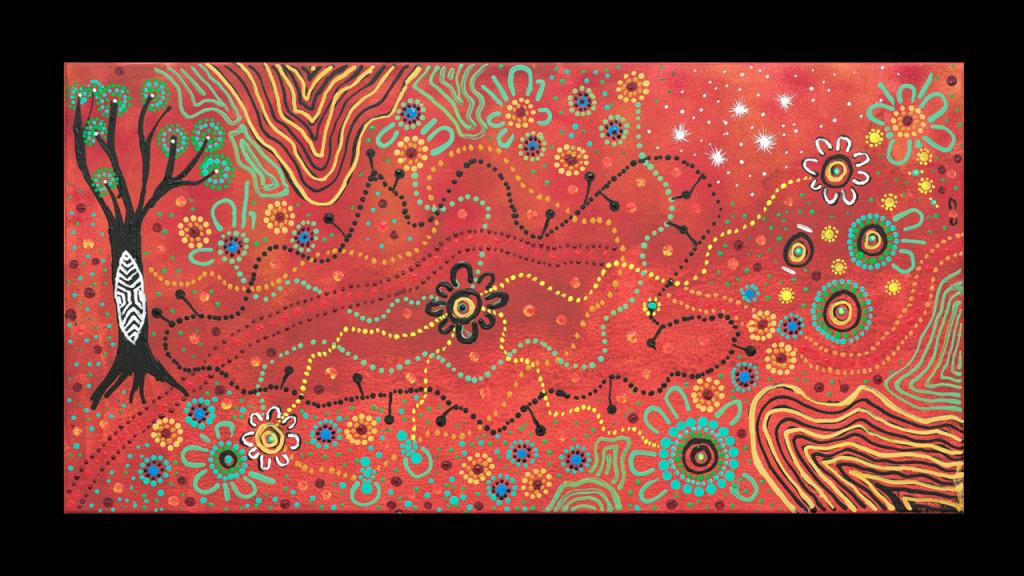
The artwork is a layered visual map of Country, movement and cultural knowledge and is strongly connected to navigation. At its heart is the central meeting place, representing Munu Wuthuga’s Dubbi Warra tribe – the place people always return to. From this centre, lines radiate outward, symbolising travel through different Countries and seasons, whether for ceremony, gathering food or survival. These pathways echo ancient songlines: sung maps used to navigate land where landmarks such as scar trees, waterholes and mountains confirm direction and belonging.
Scarred trees also appear as key markers, indicating sacred places, ceremonial grounds and tribal boundaries. Rivers and creeks, painted here in deep reds, flow through the composition as lifelines, guiding movement and preventing people from becoming lost. Stars appear above, referencing night-time navigation and spiritual connection to the sky world. Around the pathways are symbols of campsites and family groups, shown through circles and U-shapes that distinguish men, women and children.
A dotted black line represents the old law – unchanging cultural rules, roles and ancestral presence that continue to guide life today. Beneath and around it, vibrant colours reflect land form, seasons, flowers, water and unity. Together, these elements create a living map that expresses balance, survival and deep respect for Country.
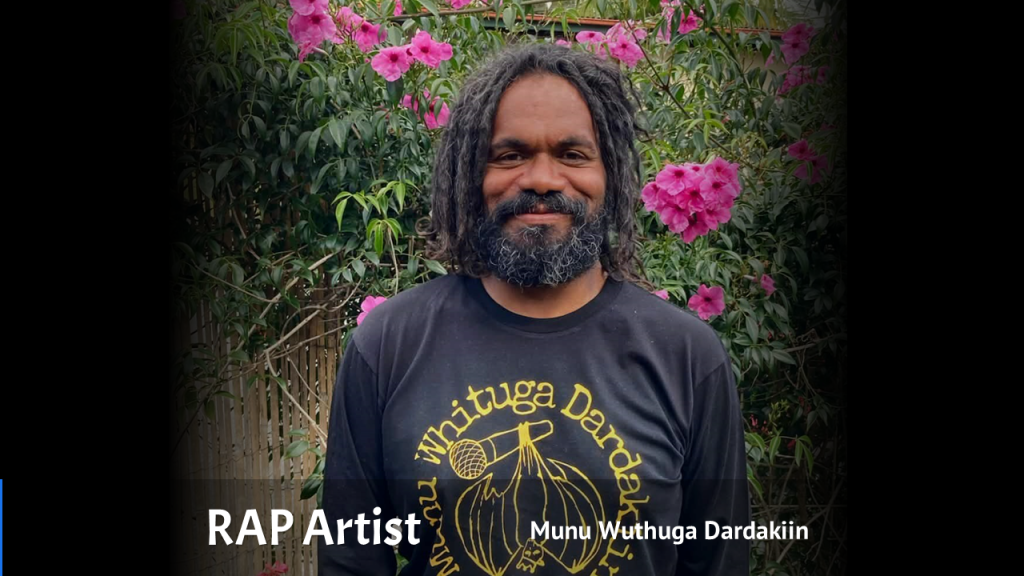
Munu Wuthuga Dardakiin is an Aboriginal artist whose life and creative practice are deeply grounded in Country, culture and story. His people come from Cape York, north of Cooktown. His tribe is Dubbi Warra (prounced Doopi Wadda), and his language, Guugu Yimithirr, is still spoken fluently today, something he holds with immense pride.
When Munu was 11, his mother took him back to her Country in Cape York, where Elders decided it was important for him to learn traditional ways. Growing up immersed in land and community, he learned language, hunting, gathering and the responsibilities each person holds within the tribe.
From an early age, Munu showed a natural talent for drawing, first sketching images in the dirt with other children. While art was always present, it became a serious path later in life, when he committed to painting as a way of keeping cultural knowledge alive. Painting is medicine for him; something that brings peace, healing and connection to culture and ancestors.
More recently, this creative energy has expanded into music and singing, allowing him to become a songman and storyteller in another form. Through painting, language and song, Munu continues to honour his ancestors and share knowledge of land, culture and spirit.